
Narrow Apartment Entryway Ideas That Make a Skinny Hallway Feel Wide Open
My first apartment had a hallway so narrow I could touch both walls at once, and every time I walked in, it felt more like a tunnel than a home.
I kept putting off decorating it because I assumed a “real” entryway needed space I just didn’t have. Then a friend pointed out that a mirror, a runner, and one slim wall-mounted shelf were all it actually took.
Within a weekend, that same tunnel felt bright, wide, and intentional — no walls knocked down, no square footage added. If you’re standing in a hallway that feels tighter than it should, you’re not stuck.
You just need ideas built for narrow, not small.
Table of Contents
- Top 5 Products for Narrow Entryway Hallways
- Idea 1: Mount a Floating Console Instead of a Freestanding One
- Idea 2: Hang a Large Mirror to Visually Double the Width
- Idea 3: Add a Runner Rug That Stretches the Space Visually
- Idea 4: Install Wall Sconces Instead of Floor or Table Lamps
- Idea 5: Use a Slimline Wall-Mounted Coat Rack Instead of a Freestanding One
- Idea 6: Paint or Wallpaper With Light, Elongating Tones (Homeowners)
- Idea 7: Create a Gallery Wall to Draw the Eye Down the Hallway
- How to Choose the Right Ideas for Your Narrow Hallway
- FAQs About Narrow Apartment Entryways
Top 5 Products for Narrow Entryway Hallways
- Wall-Mounted Floating Console Table – This legless console gives you a usable surface at under 8 inches deep so it never blocks a narrow walkway.
- Extra-Long Runner Rug (2×8 ft) – This slim jute runner visually stretches the hallway and adds texture without narrowing the walking path.
- Large Round Wall Mirror – This mirror bounces light down a dim hallway and tricks the eye into reading the space as wider than it is.
- Battery-Operated LED Wall Sconces – These plug-free, adhesive-mount sconces add warm lighting to dark stretches of hallway without any wiring or drilling.
- Slimline Wall-Mounted Coat Hook Rack – This shallow hook rack hangs coats and bags flat against the wall so nothing juts into your path.
Idea 1: Mount a Floating Console Instead of a Freestanding One
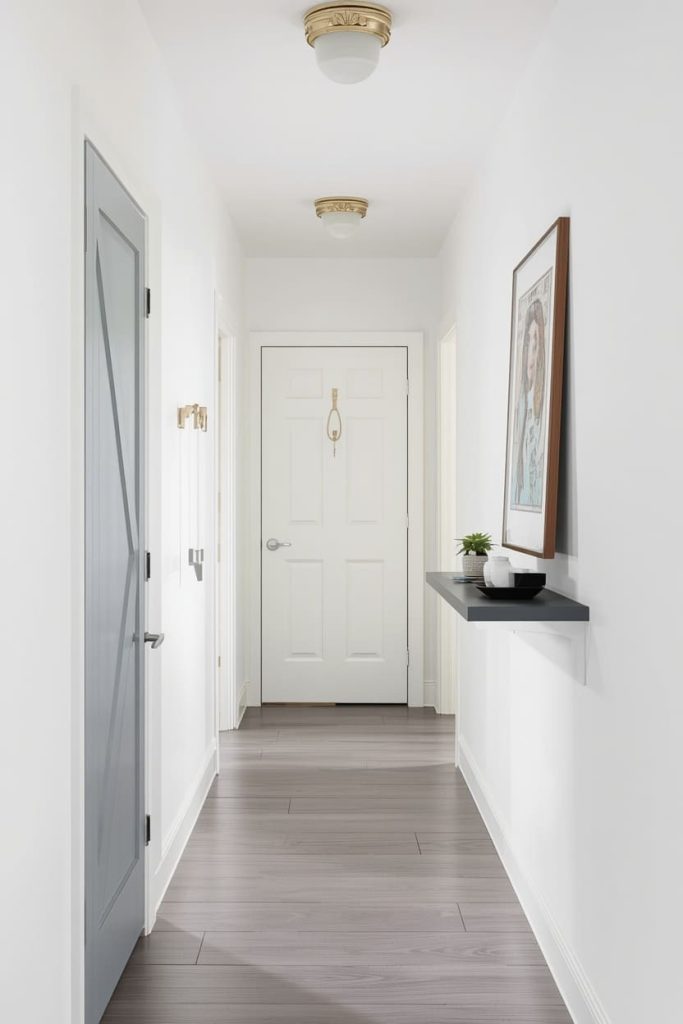
A regular console table can turn a narrow hallway into an obstacle course. A wall-mounted, legless console solves that instantly. Budget tier: $60–$100.
How to do it:
- Measure your hallway’s width and subtract at least 24 inches for clear walking space — whatever’s left is your max console depth.
- Choose a floating console under 8 inches deep if your hallway is under 36 inches wide.
- Mount using the included brackets (renters: check if a stud-free, weight-rated wall anchor kit is included or needed).
- Style the top with one tray, one small plant, and a dish for keys — narrow surfaces get cluttered fast, so less is more here.
This is the single best swap for narrow spaces because it adds function without stealing an inch of your walkway.
Idea 2: Hang a Large Mirror to Visually Double the Width
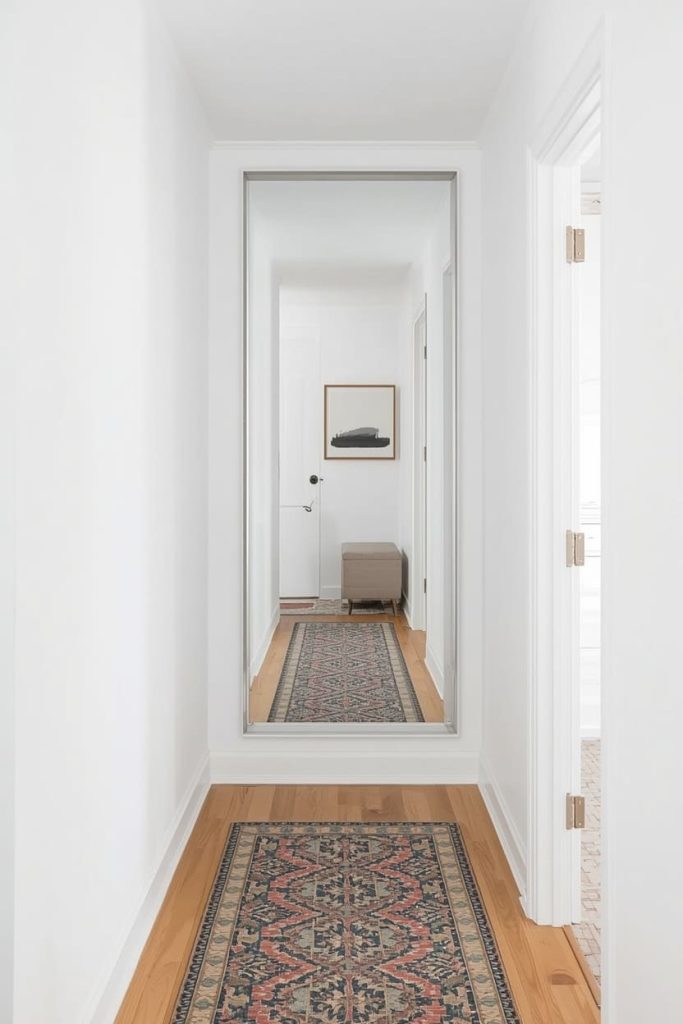
This is the cheapest, highest-impact trick for narrow hallways, and it works whether you rent or own. Budget tier: $40–$90.
How to do it:
- Choose a mirror as large as your wall comfortably allows — bigger reads as more impactful than a small accent mirror.
- Position it across from or near a light source (a window, a sconce, or even a lamp) so it reflects light down the hall.
- Hang using weight-rated Command strips for a no-drill option, or a picture hook and stud if you own your place.
- Angle it slightly if the hallway feels like a straight tunnel — a mirror reflecting an adjacent room can make the space feel like it continues further than it does.
A mirror is the one item on this list that every narrow-hallway list agrees on, and for good reason: it changes the whole feel of the space for under $50.
Idea 3: Add a Runner Rug That Stretches the Space Visually
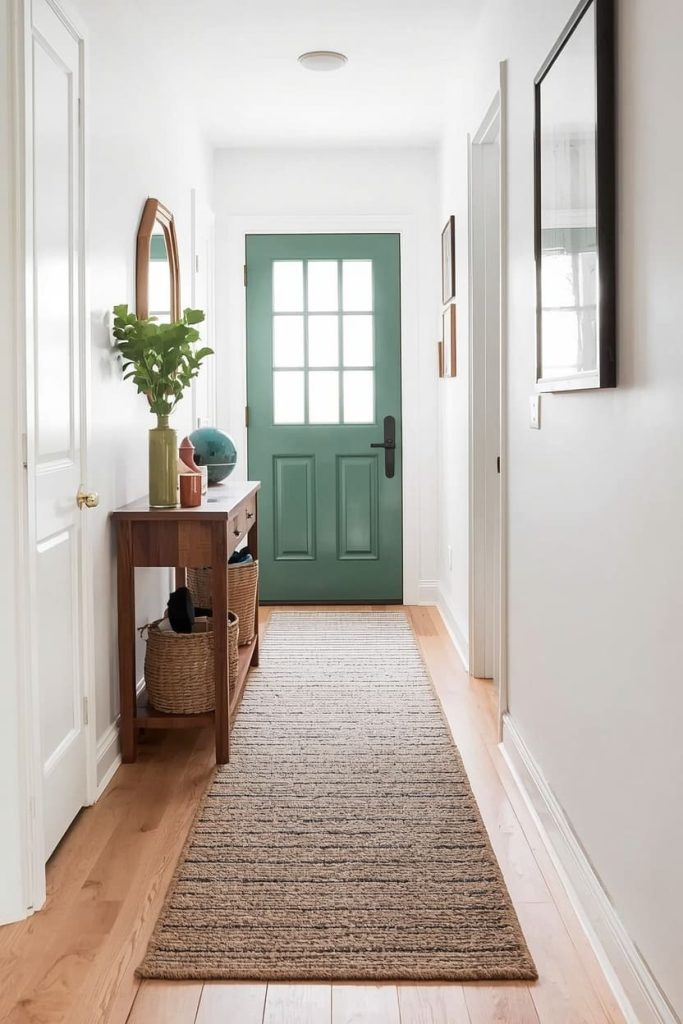
A runner does for the floor what a mirror does for the wall — it lengthens and defines the space. Budget tier: $30–$80.
How to do it:
- Measure your hallway’s full length and leave 3–4 inches of bare floor on each side of the rug.
- Choose a low-pile, flatweave, or jute runner so it doesn’t add bulk or trip hazards in a tight walkway.
- Add non-slip rug tape or a thin rug pad underneath — essential in narrow hallways where the rug gets constant foot traffic.
- Pick a pattern that runs lengthwise (stripes, chevrons) rather than busy all-over prints, since linear patterns visually stretch a narrow space.
This is one of the easiest upgrades because it requires zero wall-mounting and works in rented or owned spaces equally well.
Idea 4: Install Wall Sconces Instead of Floor or Table Lamps
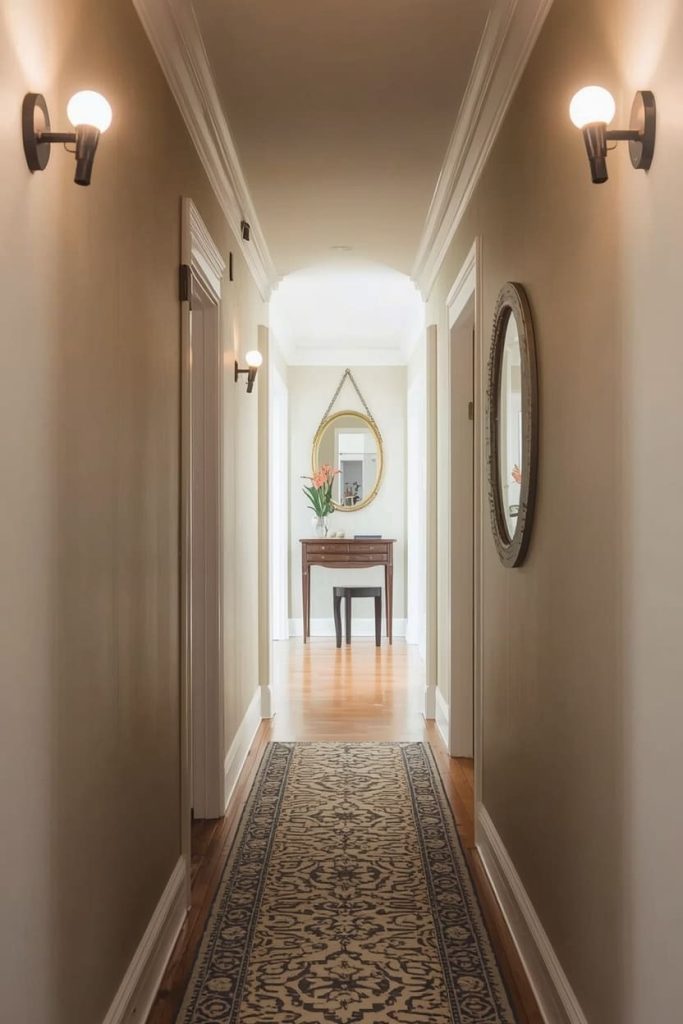
Narrow hallways are often dim because there’s no room for a floor lamp and no natural light. Sconces solve this without touching your floor space. Budget tier: $30–$70.
How to do it:
- Choose battery-operated or plug-in wall sconces if you’re renting and can’t wire anything permanently.
- Mount at eye level or slightly above, spaced evenly if your hallway is long enough for two.
- Use warm white bulbs (2700K–3000K) to avoid a clinical, cold feel in a tight space.
- Turn them on in the evening as your main hallway light instead of a harsh overhead fixture — it instantly makes the space feel warmer and more considered.
Because sconces mount flush to the wall, they solve the lighting problem without ever creating a bottleneck.
Idea 5: Use a Slimline Wall-Mounted Coat Rack Instead of a Freestanding One
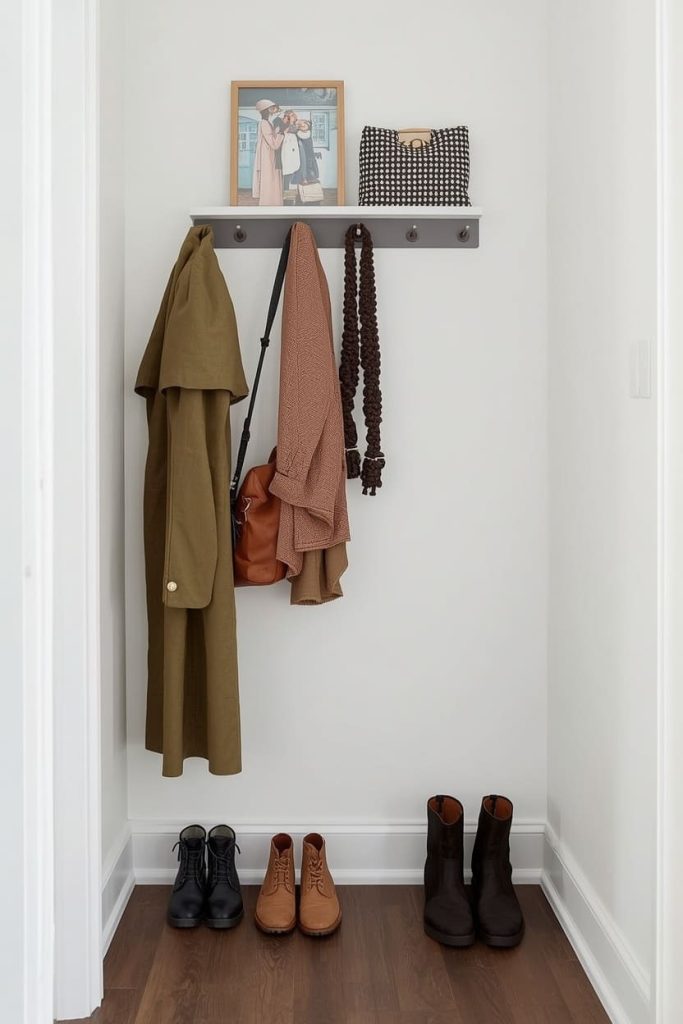
Freestanding coat racks and umbrella stands are the number one culprit for narrow hallway bottlenecks. A flush-mounted rack fixes that. Budget tier: $20–$50.
How to do it:
- Choose hooks or a rack that sits flush or nearly flush against the wall rather than protruding hooks that stick out several inches.
- Mount at a height where hanging coats won’t drag on the floor or block the walkway when swinging.
- Space hooks based on your household — 2–3 hooks per person is usually enough without overcrowding the wall.
- Use adhesive mounts if renting, weight-rated for coats and bags (5–10 lbs per hook is typical).
This keeps outerwear off the floor and out of the walking path — a small change that makes a narrow hallway feel dramatically less cramped.
Idea 6: Paint or Wallpaper With Light, Elongating Tones (Homeowners)
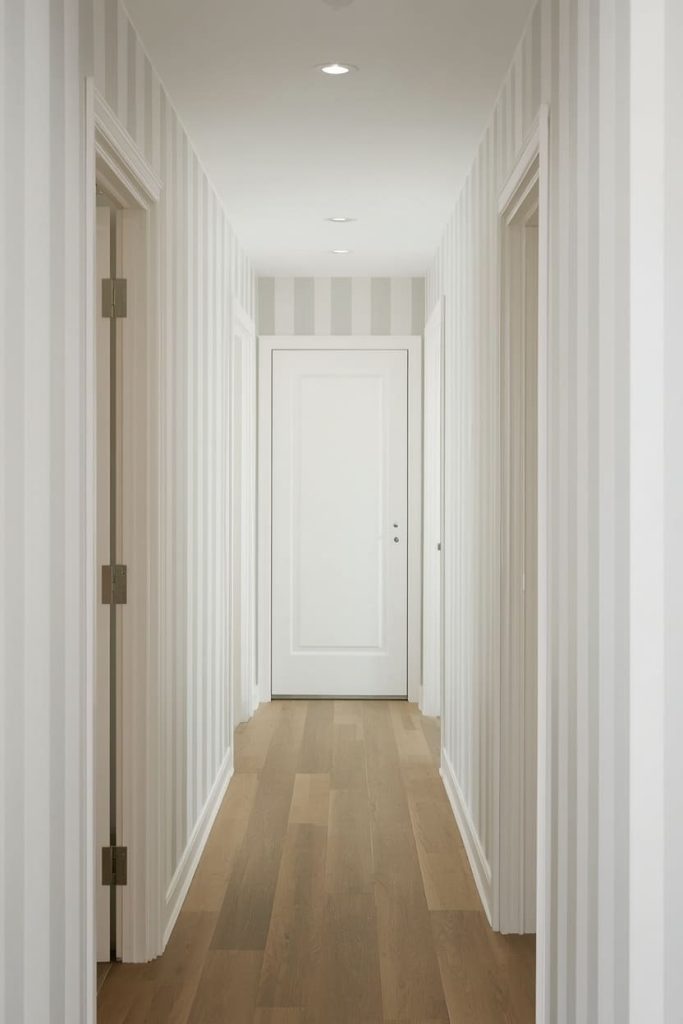
If you own your space, color is one of the most powerful tools for a narrow hallway. Budget tier: $50–$150.
How to do it:
- Choose light, warm neutrals (soft white, pale greige, light sage) to reflect more light and open up the space visually.
- If you want pattern, pick a vertical-striped or elongated wallpaper motif, which draws the eye up and down rather than side to side.
- Paint the ceiling a shade lighter than the walls to prevent the hallway from feeling like a low, boxed-in tunnel.
- Finish in a satin or eggshell sheen rather than flat — it reflects more ambient light down a dim hallway.
This is the one idea reserved for homeowners or renters with painting permission, but it delivers the most dramatic transformation on the list.
Idea 7: Create a Gallery Wall to Draw the Eye Down the Hallway
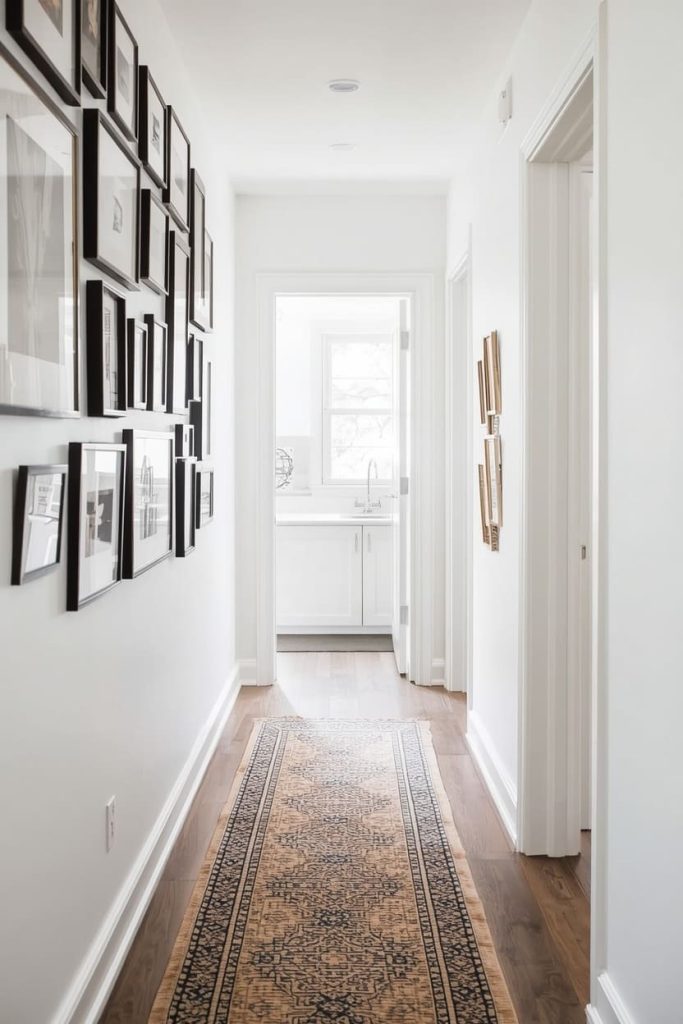
A well-placed gallery wall turns a narrow hallway into a design feature instead of a problem to hide. Budget tier: $40–$100.
How to do it:
- Choose slim frames (under 1 inch deep) so nothing protrudes into the walkway.
- Lay your frames out on the floor first to plan spacing before hanging anything.
- Hang using Command picture-hanging strips for a no-damage option that holds securely.
- Run the gallery the full length of the hallway rather than clustering it in one spot — this visually extends the space and gives guests a reason to slow down and look, instead of feeling like they’re rushing through a tunnel.
This idea works especially well paired with a runner rug underneath, since both elements draw the eye lengthwise through the space.
How to Choose the Right Ideas for Your Narrow Hallway
If your biggest issue is darkness, start with the mirror and sconces. If it’s visual monotony, start with the runner and gallery wall. If you’re a renter worried about damage, prioritize the floating console, adhesive hooks, and Command-strip mirror before touching paint or wallpaper. As with any small-space project, pick two or three ideas rather than tackling all seven at once — narrow hallways respond best to a few well-chosen, low-profile pieces rather than a lot of competing elements.
FAQs About Narrow Apartment Entryways
How do I make a narrow hallway feel wider?
A large mirror is the single most effective trick — it reflects light and visually doubles the perceived width of the space. Pairing it with a lengthwise-patterned runner rug and light wall colors reinforces the effect even further.
What’s the maximum depth of furniture I should use in a narrow entry?
As a general rule, keep furniture under 10 inches deep if your hallway is less than 36 inches wide, and leave at least 24 inches of clear walking space at all times. Wall-mounted, floating pieces are the safest choice when you’re unsure.
Will a mirror really help a tunnel-like hallway?
Yes — mirrors reflect both natural and artificial light, which brightens the space and creates the illusion of depth. Position it near a light source, like a window or sconce, for the strongest effect.
Can I decorate a narrow hallway if I’m renting and can’t drill or paint?
Definitely. Adhesive strips, battery-operated sconces, floating console tables with no-drill mounting options, and runner rugs all work without any permanent changes to the walls or floors.
Won’t adding furniture make a narrow hallway feel more crowded?
Not if you choose wall-mounted, shallow pieces over freestanding furniture. The goal is to add function vertically (on the wall) rather than horizontally (on the floor), which keeps the walkway clear while still adding storage and style.
What lighting works best in a dark, narrow hallway?
Wall sconces are ideal since they add light without taking up floor space the way a lamp would. Choose warm white bulbs and, if possible, place one near a mirror to maximize the brightness they cast down the hall.
A narrow hallway isn’t a flaw to hide — it’s just a shape that needs the right tools. Pick one idea from this list and try it this weekend. You might be surprised how much wider your “tunnel” starts to feel.

Emily Harper is a kitchen decor expert and interior designer with a passion for creating stylish, functional spaces. As a busy mom, she understands the importance of a kitchen that works for both family life and design. With 6 years of experience, Emily specializes in transforming kitchens into inviting, practical spaces. She’s known for her ability to blend trends with everyday needs, helping families create kitchens that feel like the heart of the home.