
Why I Finally Fixed My Chaotic Entryway (And You Can Too)
I still remember the exact moment I hit my breaking point. It was raining, I was juggling grocery bags, and I tripped over a pile of sneakers my kids had kicked off by the door — again.
My husband stepped over the mess without even noticing, because by then it was just… normal. That was the day I decided our tiny entryway wasn’t going to run my life anymore.
I spent weeks testing ideas in our cramped 6-foot-wide entry, and I’m sharing everything that actually worked — no expensive renovations, no extra square footage required. J
Trust real solutions for real small spaces.
Table of Contents
- My Top 5 Shoe Storage Picks From Amazon
- How to Measure Your Entryway Before You Buy Anything
- Idea 1: Build a Slim Shoe Bench With Baskets Underneath
- Idea 2: Hang an Over-the-Door Organizer for Zero-Floor-Space Storage
- Idea 3: Create a Wall-Mounted Shelf With Hooks Above It
- Idea 4: Use a Slim Rolling Cart for Flexible Storage
- Idea 5: Install a Closed Cabinet for a Clutter-Free Look
- Idea 6: Repurpose a Bookshelf Turned Sideways as a Shoe Cubby
- Idea 7: Add a Boot Tray Plus Wall Hooks for a No-Furniture Solution
- Common Mistakes to Avoid With Small Entryway Storage
- How to Keep Shoe Clutter From Coming Back
- FAQs About Small Entryway Shoe Storage
- Final Thoughts
My Top 5 Shoe Storage Picks From Amazon
Before I get into the full ideas, here are the five products I personally rely on (or wish I’d bought sooner) — all budget-friendly and perfect for tight entryways.
- SONGMICS Shoe Bench with Cushion — A slim storage bench that gives you a place to sit while putting shoes on and hides at least 8 pairs underneath. [Amazon link]
- mDesign Over-the-Door Shoe Organizer — Uses zero floor space by hanging on any door, which is a lifesaver in apartments with no coat closet. [Amazon link]
- Simple Trending 2-Tier Shoe Rack — A narrow, stackable metal rack that fits perfectly against a wall in hallways as tight as 12 inches. [Amazon link]
- Whitmor Expandable Shoe Rack — Adjusts to fit your exact space, so it works whether your entryway is 2 feet or 5 feet wide. [Amazon link]
- Internet’s Best Shoe Cubby Storage Cabinet — A closed-door cabinet that keeps shoes completely out of sight for a clean, guest-ready look. [Amazon link]
How to Measure Your Entryway Before You Buy Anything
I made the mistake of buying a shoe bench that was two inches too deep for my hallway, and it blocked our front door from opening fully. Don’t repeat my error.
Grab a tape measure and note three numbers: the total width of your entry wall, the depth from wall to any obstruction (door swing, stairs, another wall), and the height up to a light switch or window if you’re considering wall-mounted storage. Write these down on your phone before you shop. Most small entryway storage products list their dimensions clearly, so having your numbers ready means you can compare in seconds instead of guessing and returning items later.
Idea 1: Build a Slim Shoe Bench With Baskets Underneath
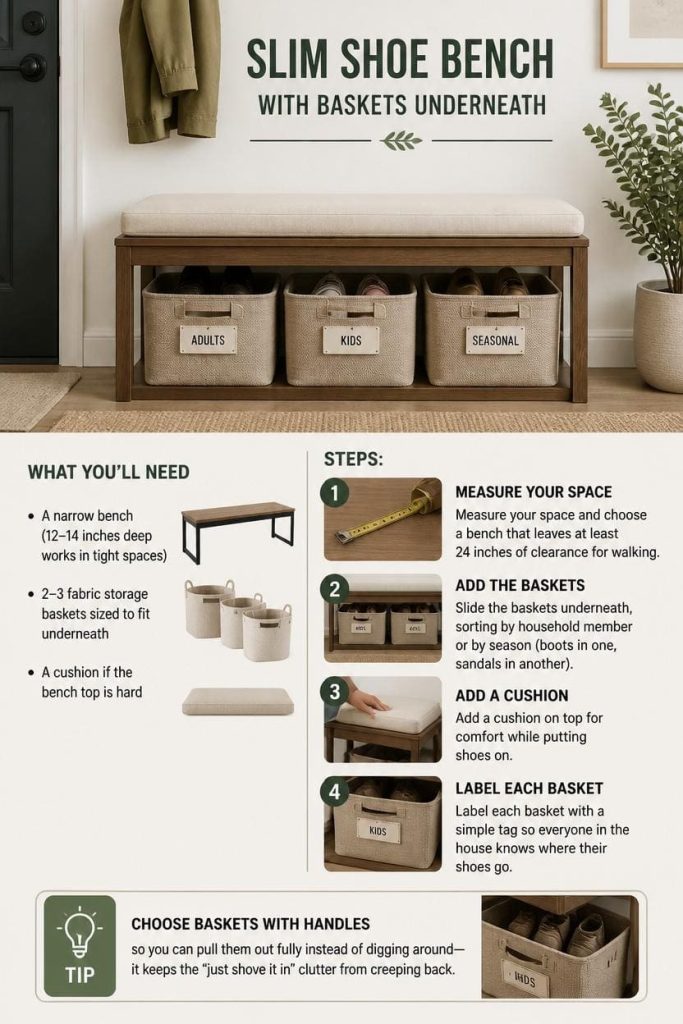
This was the first thing I built, and it’s still the piece that gets the most compliments. A shoe bench does double duty — seating plus storage — which matters when your entryway can’t fit separate furniture pieces.
What you’ll need: A narrow bench (12–14 inches deep works in tight spaces), 2–3 fabric storage baskets sized to fit underneath, and a cushion if the bench top is hard.
Steps:
- Measure your space and choose a bench that leaves at least 24 inches of clearance for walking.
- Slide the baskets underneath, sorting by household member or by season (boots in one, sandals in another).
- Add a cushion on top for comfort while putting shoes on.
- Label each basket with a simple tag so everyone in the house knows where their shoes go.
Tip: Choose baskets with handles so you can pull them out fully instead of digging around — it keeps the “just shove it in” clutter from creeping back.
Idea 2: Hang an Over-the-Door Organizer for Zero-Floor-Space Storage
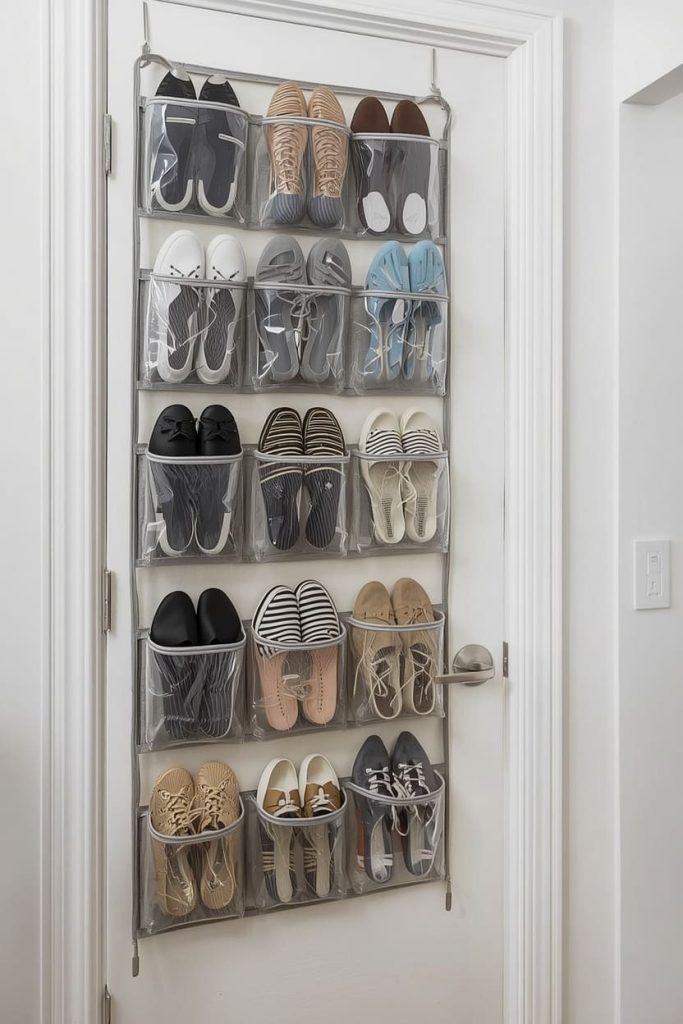
If your entryway is basically a hallway with no room for furniture at all, this is your best friend. It uses vertical space you weren’t using anyway.
What you’ll need: An over-the-door fabric or clear-pocket organizer, and any interior door near your entrance (a coat closet door works great, or even the door to a nearby room).
Steps:
- Hang the organizer over the top of the door — most just hook over, no tools needed.
- Assign each pocket to a specific pair or a specific person.
- Keep the most-used shoes in the lowest, easiest-to-reach pockets.
- For kids, use the bottom row so they can grab their own shoes independently.
Tip: If you don’t want it visible from your main living area, use the back of a closet door instead of a door that faces your entryway directly.
Idea 3: Create a Wall-Mounted Shelf With Hooks Above It
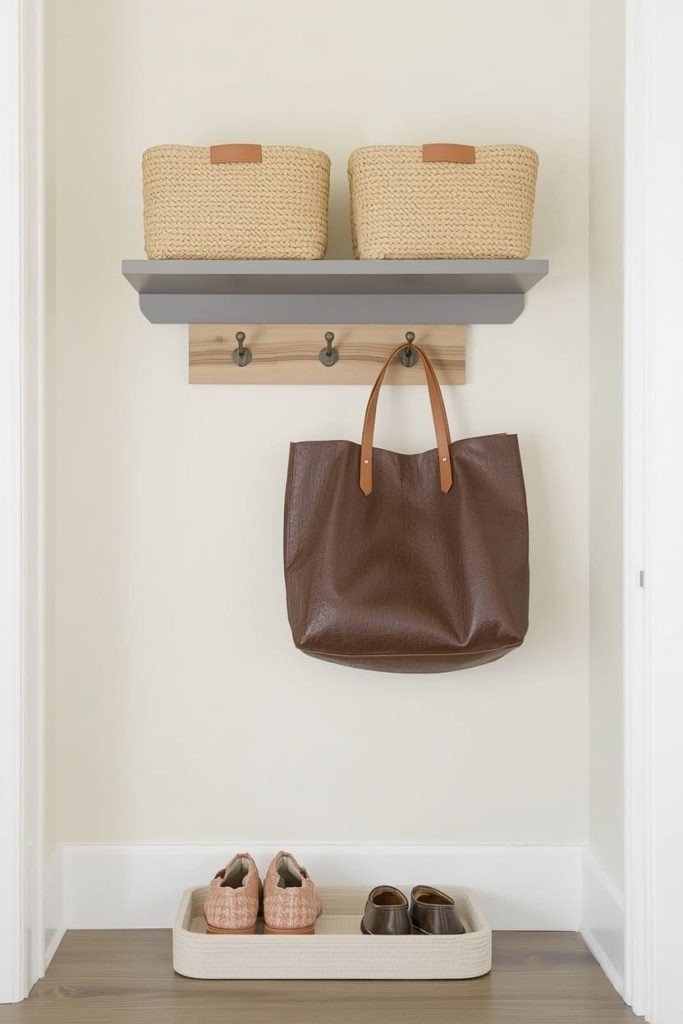
This idea solved two problems for me at once: shoes and the pile of bags and jackets that always ended up on the floor too.
What you’ll need: A floating shelf (18–24 inches works well for small spaces), 3–4 wall hooks, wall anchors, a drill, and a level.
Steps:
- Mark your shelf height — I recommend about 12 inches off the ground so shoes fit underneath, not on top.
- Use a level to mark your drill points, then install wall anchors for stability.
- Mount the shelf securely, then add hooks in the wall space above it for bags, umbrellas, or leashes.
- Place shoes underneath the shelf in a simple tray to catch dirt and mud.
Tip: Paint the shelf a color that blends with your wall if you want it to feel less bulky visually — this trick makes small spaces feel bigger.
Idea 4: Use a Slim Rolling Cart for Flexible Storage
I love this one for renters, because nothing gets attached to the wall and you can move it wherever you need it.
What you’ll need: A narrow 2–3 tier rolling utility cart, and small bins or trays that fit each shelf.
Steps:
- Choose a cart no wider than 12–16 inches so it slides into narrow gaps, like beside a door or in a coat closet.
- Sort shoes onto each tier — everyday shoes on top, seasonal or occasional shoes lower down.
- Roll it out of the way when you’re expecting guests, and back into place afterward.
- Add a small bin on top for keys, mail, or sunglasses to make it a full entry “landing zone.”
Tip: Look for a cart with locking wheels so it doesn’t roll away every time someone grabs a shoe.
Idea 5: Install a Closed Cabinet for a Clutter-Free Look
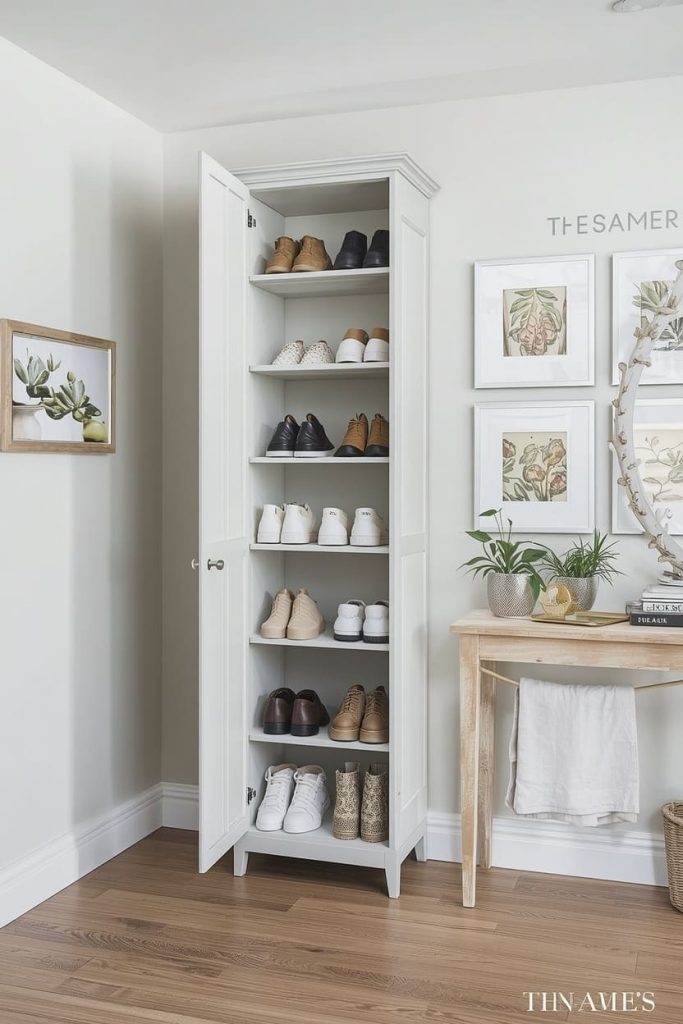
If you want your entryway to look completely clean the second someone walks in, a closed shoe cabinet is worth the investment.
What you’ll need: A slim shoe storage cabinet (many are designed to be only 8–10 inches deep), and a wall spot with at least 30 inches of width.
Steps:
- Measure your wall space and confirm the cabinet depth won’t block foot traffic.
- Assemble the cabinet following the included instructions — most flat-pack versions take under an hour.
- Organize shoes by household member on separate shelves inside.
- Top the cabinet with a small tray or decorative item to make it double as an entry table.
Tip: Choose a cabinet with flip-down or tilt-out doors instead of swinging doors if your space is extra tight — they need less clearance to open.
Idea 6: Repurpose a Bookshelf Turned Sideways as a Shoe Cubby
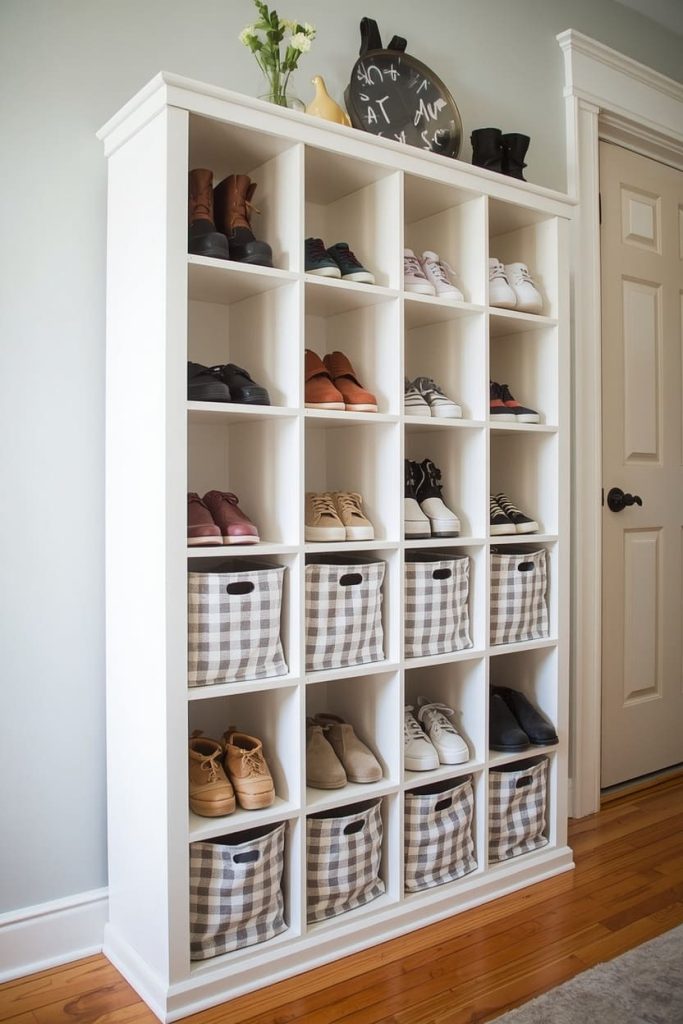
This is my favorite budget hack, because it turns something you might already own (or find secondhand) into custom shoe storage for free.
What you’ll need: A small bookshelf with cube-style compartments, and optional fabric bins to fit each cube.
Steps:
- Lay the bookshelf on its side so the cubbies run horizontally instead of vertically.
- Secure it to the wall with an anti-tip strap for safety, especially if you have kids.
- Assign one cube per shoe pair, or use fabric bins for a more finished look.
- Place it along the shortest wall in your entry to avoid blocking the walkway.
Tip: Thrift stores and marketplace listings are goldmines for cube shelving — I found mine secondhand for $15 and gave it a quick coat of paint.
Idea 7: Add a Boot Tray Plus Wall Hooks for a No-Furniture Solution
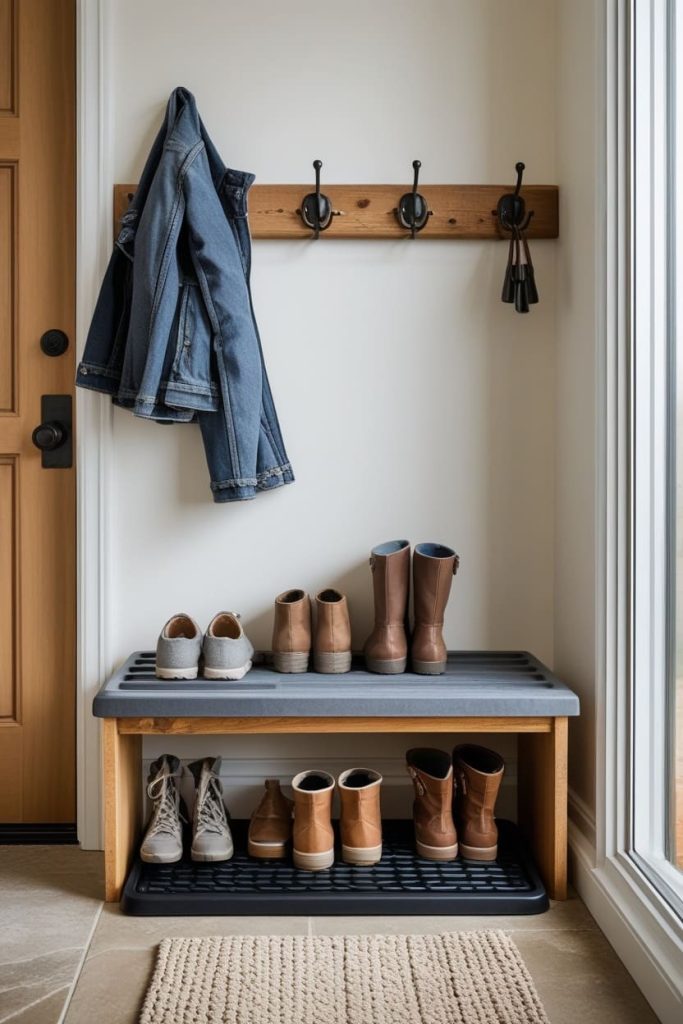
Sometimes the smallest space needs the simplest fix. If you genuinely have no room for a bench, cart, or cabinet, this combo still keeps shoes contained and off your floor.
What you’ll need: A waterproof boot tray, and 3–4 adhesive or screw-in wall hooks placed at varying heights.
Steps:
- Place the boot tray just inside your door, angled so it doesn’t block the swing.
- Install hooks above it at heights that work for each family member (lower ones for kids).
- Use the tray strictly for shoes that get worn daily — anything else goes elsewhere.
- Wipe the tray down weekly since it catches dirt and moisture.
Tip: Choose a tray with raised edges if you live somewhere rainy or snowy — it contains water and slush far better than a flat mat.
Common Mistakes to Avoid With Small Entryway Storage
I made most of these mistakes myself before I got it right. Skip them by learning from my trial and error:
- Buying storage before measuring. Even an inch too wide can block a door or walkway.
- Storing every pair you own. Small entryways can’t hold your entire shoe collection — rotate seasonal shoes to a closet elsewhere.
- Ignoring vertical space. Most people only think about floor space, but walls and doors are often your biggest opportunity.
- Choosing open shelving when you actually want a clean look. If visible clutter stresses you out, a closed cabinet will serve you better long-term, even if it costs more upfront.
How to Keep Shoe Clutter From Coming Back
Buying storage is only half the battle — I learned that the hard way when my new bench was buried in shoes within two weeks. What actually worked was setting a simple household rule: shoes go directly into their assigned spot the second they come off, no exceptions. I also do a 60-second reset each evening, tossing stray shoes back where they belong before bed. If you have kids, giving them their own designated bin or hook (at their height) makes them far more likely to actually use it instead of leaving shoes on the floor.
FAQs About Small Entryway Shoe Storage
How many pairs of shoes should entryway storage hold?
For most households, storing 6–10 pairs of daily-use shoes in your entryway is realistic. Anything beyond that should live in a closet or seasonal storage bin elsewhere in your home.
What’s the cheapest way to add shoe storage in a small space?
A boot tray paired with a few wall hooks costs very little and requires no furniture at all — it’s the fastest, most budget-friendly fix I’ve tried.
Can I add shoe storage without drilling into walls?
Yes. Over-the-door organizers, rolling carts, freestanding benches, and boot trays all work without any drilling, which makes them perfect for renters.
How do I stop my entryway from smelling like shoes?
Choose storage with some airflow, like open baskets or slatted cabinets, and toss in a few charcoal deodorizer bags — they’re inexpensive and genuinely make a difference.
What’s the best shoe storage for a small apartment with no closet?
An over-the-door organizer or a slim rolling cart are your best options, since both work without needing dedicated closet or floor space.
Should kids have their own shoe storage spot?
Yes — a low hook or bin at their height encourages independence and cuts down on the “shoes everywhere” problem significantly.
Final Thoughts
A small entryway doesn’t have to mean a chaotic one. Once I stopped trying to force big-space solutions into my tiny hallway and started working with what I actually had, everything changed. Pick one or two ideas from this list that fit your space and your budget, and give yourself permission to start small. Trust me — the first time you walk through your door without tripping over a shoe, you’ll wonder why you didn’t do this sooner.

Emily Harper is a kitchen decor expert and interior designer with a passion for creating stylish, functional spaces. As a busy mom, she understands the importance of a kitchen that works for both family life and design. With 6 years of experience, Emily specializes in transforming kitchens into inviting, practical spaces. She’s known for her ability to blend trends with everyday needs, helping families create kitchens that feel like the heart of the home.